

BING-JHEN HONG/iStock Editorial via Getty Images
Taiwan Semiconductor Manufacturing Company (NYSE:TSM) (“TSMC”) posted outstanding results for its 2022 Q1, with a 36% YOY growth in revenue and a 45.7% YOY growth in income. Yet its ADR price has yet to recover from the effects of Russia’s invasion of Ukraine. While it may seem that there are parallels between Ukraine and Taiwan, in fact, Taiwan is in a much better position.
Russia’s invasion of Ukraine casts a pall over TSMC’s excellent Q1 results
Traditionally, TSMC’s Q1 revenue declines sequentially from the busy holiday quarter, more or less in lock step with Apple Inc.’s (AAPL) iPhone sales. 2021 Q1 was an exception due mainly to the late launch of Apple’s iPhone 12 series, as well as the launch of the first Apple Silicon Macs. In 2022 Q1, not only was there no sequential decline, but TSMC posted nearly 12% q/q and 36% YOY revenue growth despite the on-time September launch of iPhone 13. Clearly, TSMC’s growth is no longer fueled merely by iPhone.
TSMC had guided to revenue of $16.6-17.2 billion for Q1. Actual revenue came in at $17.567 billion. Gross margin also came in above guidance of 53-55% as did operating margin which was guided to 42-44%:
Mark Hibben based on TSMC reports.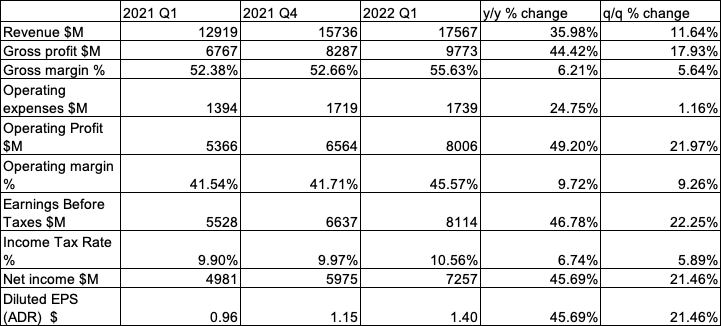
TSMC cited HPC and Automotive as the primary growth drivers for the quarter. As a reminder, High Performance Computing (HPC) includes graphics cards, PC processors and more advanced data center chips. Apple Silicon Macs are in the HPC category.
TSMC 2022 Q1 earnings report.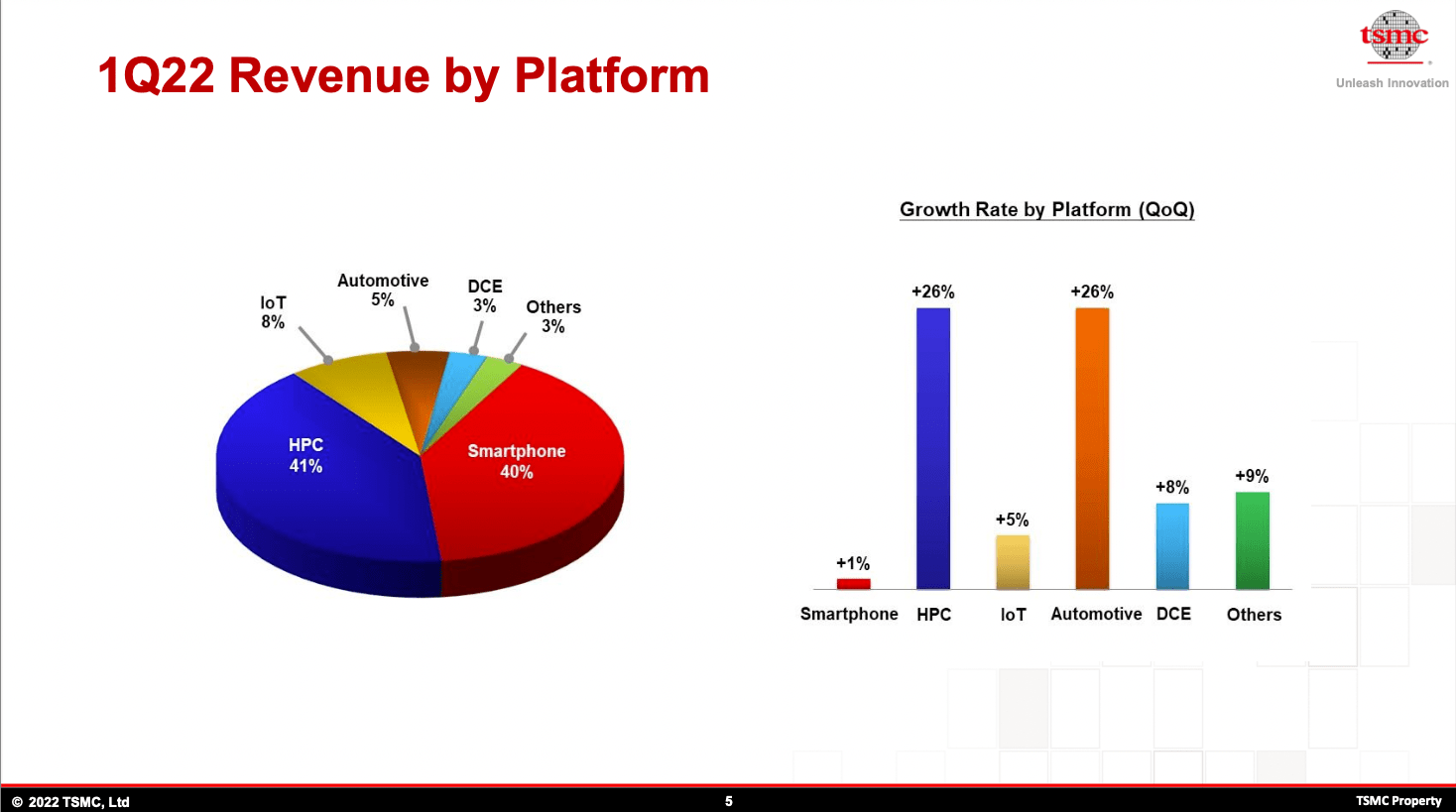
Yet, despite the excellent results, TSMC’s ADR price has yet to recover from the slide that started with the Russian invasion of Ukraine on February 24:
Yahoo Finance.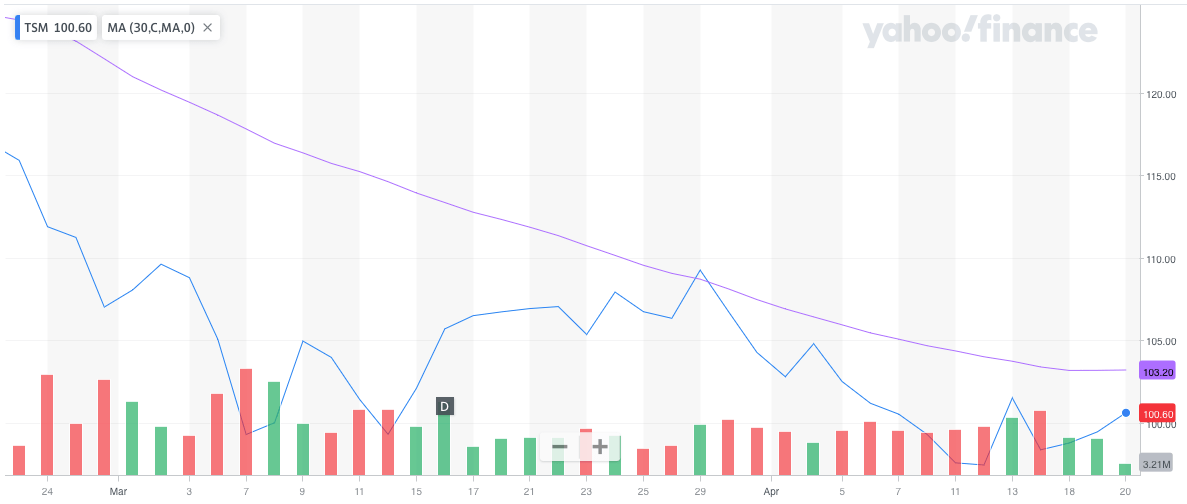
It’s not too difficult to see why. Investors are concerned that the U.S. would leave Taiwan to its own devices, as it has for the most part in Ukraine. Like Ukraine, there is no defense treaty obligating the U.S. to come to Taiwan’s aid. And like Ukraine, Taiwan must deal with a much larger neighbor, the People’s Republic, that considers Taiwan merely a rebellious province.
America’s difficult balancing act concerning Taiwan
To make matters worse, the U.S. agrees with the P.R.C., at least in principle. In one of the most grievous mistakes every committed by an American President, Jimmy Carter abandoned formal relations with Taiwan as a concession to the P.R.C. in the process of granting the P.R.C. full diplomatic recognition. Yet, under the Taiwan Relations Act, we continued cultural and economic relations with Taiwan, including selling Taiwan armaments.
The US maintains “strategic ambiguity,” refusing to say whether it would come to the aid of Taiwan if the PRC invaded. No such ambiguity was ever granted to Ukraine. The Biden administration made it clear from the outset that there would be no direct U.S. involvement in Ukraine.
But the U.S. has taken an increasingly tough position on the P.R.C., as indicated by a recent position paper issued by the Biden administration on security in Asia, called the “Indo-Pacific Strategy”:
The PRC’s coercion and aggression spans the globe, but it is most acute in the Indo-Pacific. From the economic coercion of Australia to the conflict along the Line of Actual Control with India to the growing pressure on Taiwan and bullying of neighbors in the East and South China Seas, our allies and partners in the region bear much of the cost of the PRC’s harmful behavior. In the process, the PRC is also undermining human rights and international law, including freedom of navigation, as well as other principles that have brought stability and prosperity to the Indo-Pacific.
But it also does include the usual statements supportive of the One China Policy and the delicate balancing act we do with Taiwan, captured in the Taiwan Relations Act. The Act doesn’t obligate the U.S. to help defend Taiwan. In fact, Carter unilaterally abrogated the Treaty that did obligate the U.S. when formal diplomatic relations were established with the P.R.C.
But even as the Act strips Taiwan of official recognition and bestows it on the P.R.C., the Act also makes clear that Taiwan’s future must be determined by peaceful means:
It is the policy of the United States-
(1) to preserve and promote extensive, close, and friendly commercial, cultural, and other relations between the people of the United States and the people on Taiwan, as well as the people on the China mainland and all other peoples of the Western Pacific area;
(2) to declare that peace and stability in the area are in the political, security, and economic interests of the United States, and are matters of international concern;
(3) to make clear that the United States decision to establish diplomatic relations with the People’s Republic of China rests upon the expectation that the future of Taiwan will be determined by peaceful means;
(4) to consider any effort to determine the future of Taiwan by other than peaceful means, including by boycotts or embargoes, a threat to the peace and security of the Western Pacific area and of grave concern to the United States;
(5) to provide Taiwan with arms of a defensive character; and
(6) to maintain the capacity of the United States to resist any resort to force or other forms of coercion that would jeopardize the security, or the social or economic system, of the people on Taiwan.
But of course, a capacity to resist any resort to force is not necessarily the will to do so.
U.S. and Chinese economic interests in Taiwan
Unlike Ukraine, the U.S. has vital interests to protect in Taiwan. Taiwan is the source of billions of dollars of advanced semiconductors, many of which cannot be made elsewhere. U.S. companies such as Apple, AMD (AMD), Nvidia (NVDA) and even Intel (INTC) rely on TSMC and other Taiwanese companies for their products.
China also has a vital interest in preserving the Taiwanese electronics industry. As of 2020, many mainland Chinese companies such as Huawei can no longer take advantage of TSMC’s most advanced fabrication nodes because they use U.S. technology. However, China still benefits from TSMC’s advanced semiconductor production.
The output from TSMC’s most advanced 5 nm and 7 nm processes still flows into products designed by companies such as Apple that are assembled by Taiwanese companies such as Hon Hai Precision (Foxconn) on mainland China. Foxconn alone employs over a million workers on the mainland. These activities are a vital source of employment and foreign exchange.
And even though P.R.C companies are denied the most advanced semiconductors, Chinese companies can and do buy less advanced semiconductors that go into everything from toasters to electric vehicles. TSMC itself operates a chip fabrication plant in China for less advanced 16 nm and larger process nodes.
China is still TSMC’s second largest source of revenue after the U.S. For 2021, reported revenue from China of $5.62 billion at current exchange rates.
The symbiotic relationship with Taiwan goes far to explain the rather convoluted position of the P.R.C. on Taiwan. It’s a very strange relationship and distinctly Chinese in character. Officially, Taiwan is a renegade province of the P.R.C. with no official standing anywhere, especially in the United Nations.
In 1992, P.R.C. and Taiwanese representatives met informally, and out of that meeting emerged the supposed 1992 Consensus. Except that the P.R.C. and the Taiwanese don’t even agree on what that Consensus consists of. Both agree that there is One China, the consensus. But the P.R.C. regards itself as the legitimate ruler of that One China, while Taiwan, as the Republic of China, also regards itself as the legitimate government of China.
The only real agreement seems to be to politely ignore the disagreement. China has benefited tremendously from Taiwanese investment and knowhow. Indeed, it’s hard to conceive of a modern China without the presence of the huge manufacturing facilities operated by Foxconn and other Taiwanese companies.
There is periodic sabre rattling from the P.R.C., when it appears that the Taiwanese might declare independence, but short of that, it seems willing to leave well enough alone. The P.R.C. has not even tried to confiscate the Kinmen islands, which are only a few miles off the mainland, since it was defeated there by the Nationalists in 1949.
Wikipedia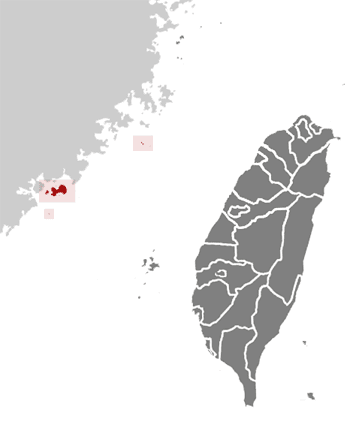
Map showing the location of the Kinmen Islands in red relative to the mainland and Taiwan.
It’s true that China and Russia have been moving closer, as the U.S. has taken a harder line on the P.R.C. China abstained from the U.N. Security Council resolution condemning the invasion of Ukraine. And, far from joining the economic sanctions on Russia, China lifted restrictions on Russian grain imports and began negotiations to increase Russian coal imports. China is already Russia’s largest trading partner.
Statements by Chinese Foreign Ministry spokesperson Hua Chunying, as reported by Politico, expressed hostility towards the U.S. and its NATO allies over the invasion:
“You keep asking when will China join the U.S. and some European countries to condemn Russia. This reminds me that it is the handful of countries you raised, including the U.S., that has been interfering in China’s internal affairs and attacking China based on disinformation,” said Hua. “Even today, China still faces a realistic threat from the U.S. flanked by its several allies as they wantonly and grossly meddle in China’s domestic affairs and undermine China’s sovereignty and security on issues, including Xinjiang, Hong Kong and Taiwan.”
The reference to Taiwan in the context of asserting U.S. interference is more than a little ominous, given that the P.R.C. initially cited U.S interference to shift blame for the invasion of Ukraine away from Russia. However, if the P.R.C. leadership were emboldened by the invasion, Russia’s subsequent frustrations in Ukraine have probably given the Chinese leadership pause.
Would the U.S. come to Taiwan’s defense? Would it need to?
Overall, Taiwan is in a much better position to defend itself from the P.R.C. than Ukraine is from Russia. Taiwan is wealthier by far and has been able to spend more for its defense. In 2019, Taiwan’s GDP was $633 billion, compared to Ukraine’s $147 billion. In 2021, Taiwan’s defense budget was $16.2 billion, compared to Ukraine’s $4.9 billion.
And the U.S. has equipped Taiwan with advanced defensive systems that even now, we deny Ukraine. These include Patriot air defense missile systems and F-16 and F-5 fighter jets armed with U.S. AMRAAM air-to-air missiles.
Recent arms purchases have included Apache Longbow attack helicopters, Blackhawk helicopters, Harpoon Block II anti-ship missiles, and even the venerable M1A2 Abrams main battle tank.
Also, Taiwan’s geography is more favorable. Instead of merely driving across a lightly defended land border, China would have to cross 100 miles of open ocean to mount an amphibious landing. This would probably be a more difficult undertaking than the D-day invasion, which only had to cross the relatively narrow English Channel.
Still, one might question whether all of that would suffice to withstand the full might of the People’s Liberation Army (PLA). It might not, without U.S. direct military assistance. The most effective form of assistance that the U.S. could provide would be for the Pacific Fleet to establish a no-fly zone in the international waters of the Taiwan Strait.
Generally, the need for air superiority is assumed in order to pull off a successful amphibious invasion. We appear to have been deterred from establishing a no-fly zone over Ukraine by virtue of Putin’s threats of nuclear war if NATO intervened directly in Ukraine.
The P.R.C has no such credible threat available to them. This is due to the simple fact that China’s nuclear force is much smaller than either Russia’s or the United States’, and according to the Federation of American Scientists, is not even actively deployed:
Federation of American Scientists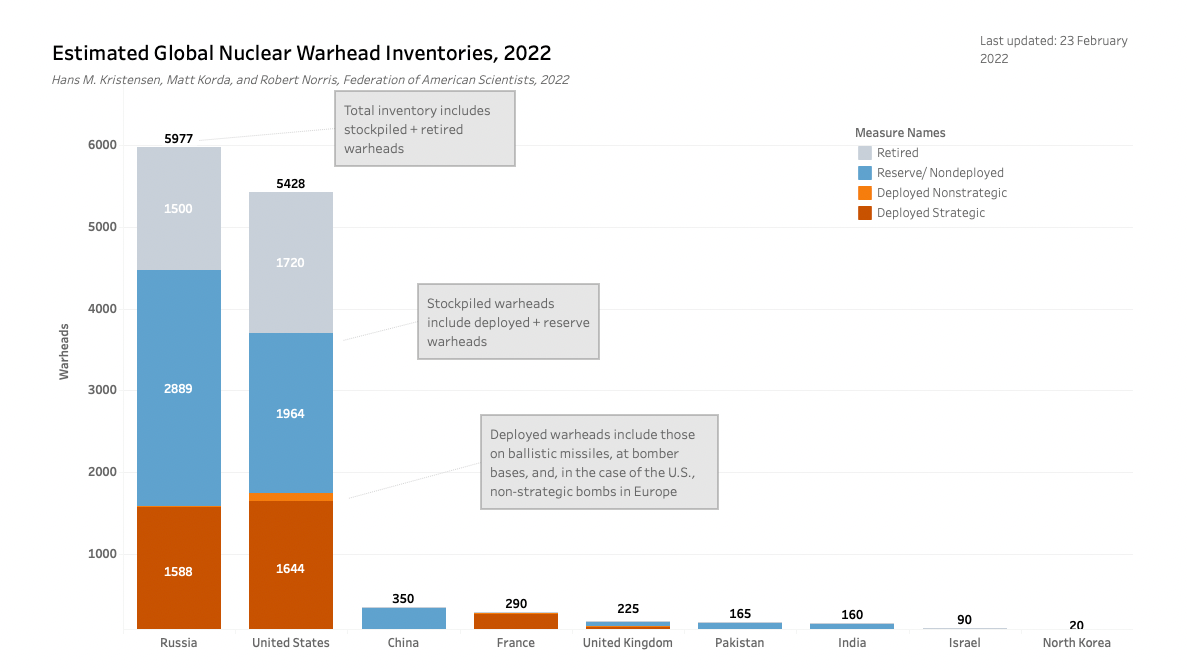
Would China want to go up against the Pacific Fleet with conventional naval and air forces? Given the technological shortcomings Russia has demonstrated in Ukraine, especially in command and control, I doubt China would do well against the U.S. in conventional naval warfare.
Investor takeaways
All of this is by way of trying to demonstrate that Taiwan’s defense situation is very different from Ukraine’s. This is not to say that there is zero risk of P.R.C. military action against Taiwan. There has never been zero risk.
But since 1949, China has not been willing to attempt a conquest of Taiwan, and the reasons are mainly geography and the role of the United States as a de facto ally of Taiwan. Those key factors are still very much in force today.
As an investor in TSMC, I don’t lose any sleep over the P.R.C. invading Taiwan. There’s no outcome of an invasion where China benefits. There’s really no military action that China could take that would not risk severe damage to Taiwan’s industry and infrastructure. That damage would just ripple back into the mainland economy.
With so little to gain and a lot to lose, the risk/reward calculation favors the P.R.C. doing nothing to alter the status quo. Current perceptions of Taiwan’s vulnerability are misplaced, and TSMC has become a bargain as a result. I remain long TSMC and rate it a Buy.
Be the first to comment